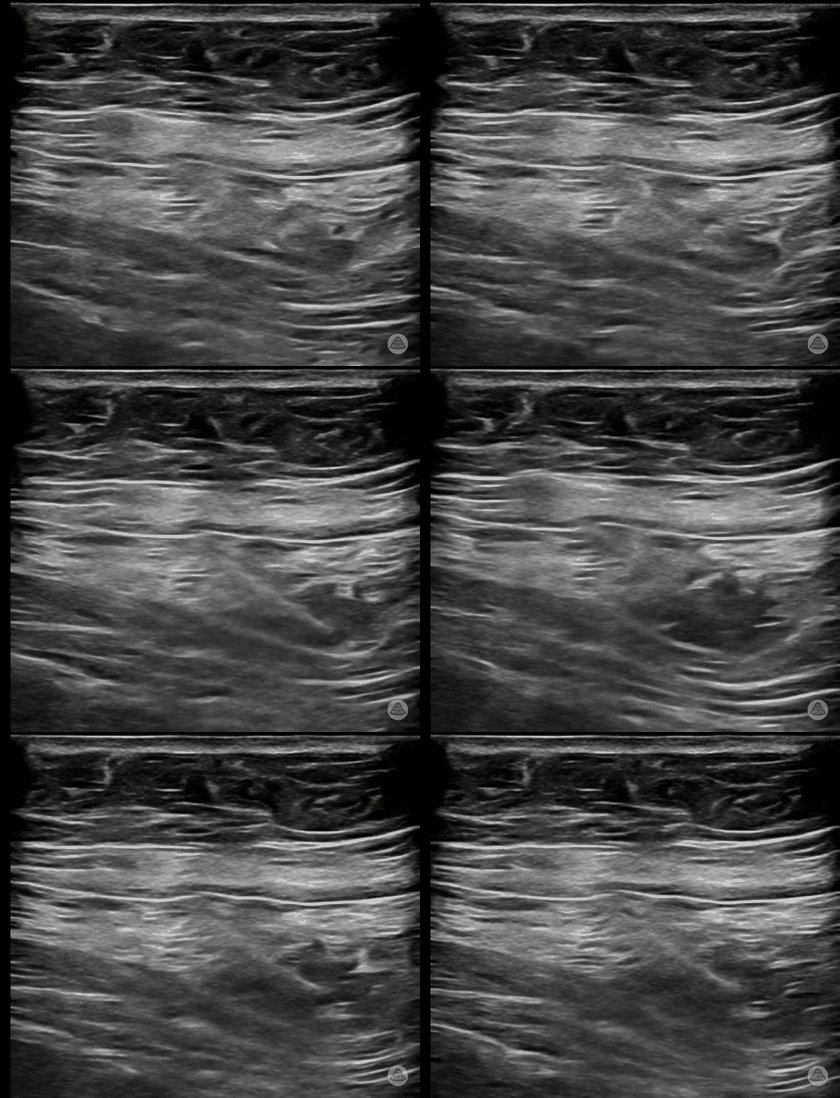
Indications
- Abdominal wall abscess drainage
- Abdominal wall laceration repair
- Unilateral abdominal pain syndromes, including appendicitis, epiploic appendagitis, renal colic, or biliary colic
- Acute or chronic abdominal pain
- Scope: The TAP block provides somatic abdominal-wall analgesia and should be used as an adjunct rather than relied upon for visceral analgesia
Contraindications
- Infection overlying injection site
- Allergy to local anesthetic
Equipment
- 15-20cc total of local anesthetic of choice
- Calculate the maximum safe dose before performing the block to reduce the risk of local anesthetic systemic toxicity
- 20-22G, 5-10cm nerve block needle
- Cleansing solution
- Ultrasound with high-frequency linear transducer
- Consider a curvilinear transducer for obesity or a posterior approach
- Ultrasound transducer sterile cover
Preparation
Position
- Position the patient supine
- Place the transducer transversely between the inferior costal margin and iliac crest along the mid-axillary line
Ultrasound
Landmarks
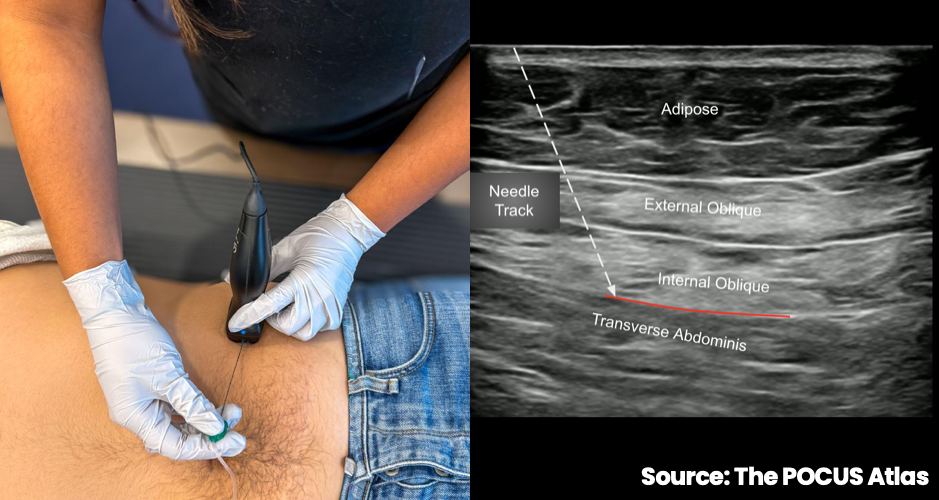
- Identify the external oblique, internal oblique, and transversus abdominis muscles from superficial to deep
- Identify the target fascial plane between the internal oblique and transversus abdominis muscles
Technique
- Advance the needle in-plane from medial to lateral
- Position the needle tip in the plane between the internal oblique and transversus abdominis muscles
- Confirm correct placement by visualizing hydrodissection of the fascial plane
- Deposit 15-20cc total of local anesthetic
Examples